
Driven by the global wave of wellness consumption and micro-nutrition, the juice market in Europe and North America has completely shifted away from traditional from-concentrate (FC) juices and high-heat centrifugal juicing. Instead, it has fully embraced cold-pressed juice, which maximizes the preservation of vitamins, minerals, and active enzymes.
For small domestic appliance buyers, brand OEM/ODM enterprises, and cross-border B2B importers, entering the premium slow juicer (also known as masticating juicer) market presents massive commercial opportunities—but it also comes with stringent regulatory barriers. This guide delivers a deep dive into the latest 2026 market trends, technological evolutions, compliance certifications, and pitfalls to avoid, helping you build a highly efficient and fully compliant supply chain.
1. 2026 Global Cold-Pressed Juice Market Outlook: North American Dominance
Before building your procurement plan, macro market data is essential to back up your purchasing decisions.
According to the latest market research reports:
- Market Size & Growth: The global cold-pressed juice market reached $1.42 billion in 2025 and is steadily climbing to $1.51 billion in 2026, growing at a CAGR of 7.11%. It is projected to cross the $2.62 billion mark by 2034.
- Absolute Dominance of North America: North America (primarily the US and Canada) remains the largest consumer market for cold-pressed juice and slow juicers, commanding an impressive 47.13% of the global market share. Intense demand from Millennials and Gen Z for 100% natural, clean-label, anti-inflammatory, and immunity-boosting juices is accelerating equipment upgrades in light-commercial kitchens, juice bars, and premium households.
- Premium Quality Demand in Europe: Germany, the UK, and France stand as the top three European markets. Consumers and regulators here place uncompromising demands on material safety (such as BPA-Free plastics) and ultra-low operating noise.
2. Core Certification Checklist: Your Passport to Western Markets
Selling electrical appliances in Western markets means compliance is your absolute lifeline. Lacking core certifications can lead to customs seizures, heavy fines, or crippling product liability lawsuits. When auditing suppliers, you must demand authentic, valid certificates issued by authoritative third-party laboratories (e.g., SGS, TÜV, Intertek).

A. The North American Market (US & Canada)
- NSF (National Sanitation Foundation): This is a mandatory sanitation design standard for commercial juicers entering US public foodservice and juice bars (typically aligning with NSF Std. 2 for catering equipment). It dictates that the machine must be incredibly easy to disassemble, have zero hygienic dead zones, and use materials that inhibit bacterial growth.
- ETL / UL (Electrical & Sanitation): These cover North American electrical safety. Commercial environments usually require the ETL Sanitation mark, indicating the product simultaneously complies with electrical safety (UL 763 standard) and sanitation safety (NSF standards).
- FDA (Food and Drug Administration): All plastic, metal, and silicone components in direct contact with juice or pulp must pass FDA Food Contact Material (FCM) testing to ensure no migration of heavy metals or harmful chemicals.
B. The European Market (EU & UK)
- CE Marking: A mandatory conformity marking for products sold within the European Economic Area (EEA), covering the LVD (Low Voltage Directive) and EMC (Electromagnetic Compatibility Directive).
- RoHS / REACH: Restricts the use of hazardous substances (such as lead, cadmium, mercury, and phthalates) in electrical components and plastic parts.
- LFGB (German Food and Feed Code): Considerably stricter than standard EU food-grade testing, the LFGB is recognized as the gold standard for food contact safety in Europe. Products with LFGB compliance command a premium market price across the continent.
3. Vertical vs. Horizontal Slow Juicers: The Ultimate Commercial & Retail Compariso
In B2B sourcing, selecting the correct form factor is vital. Slow juicers are fundamentally split into Vertical Masticating and Horizontal Masticating types. Understanding how they stack up in juice yield, noise levels, and durability helps you accurately target your client base.
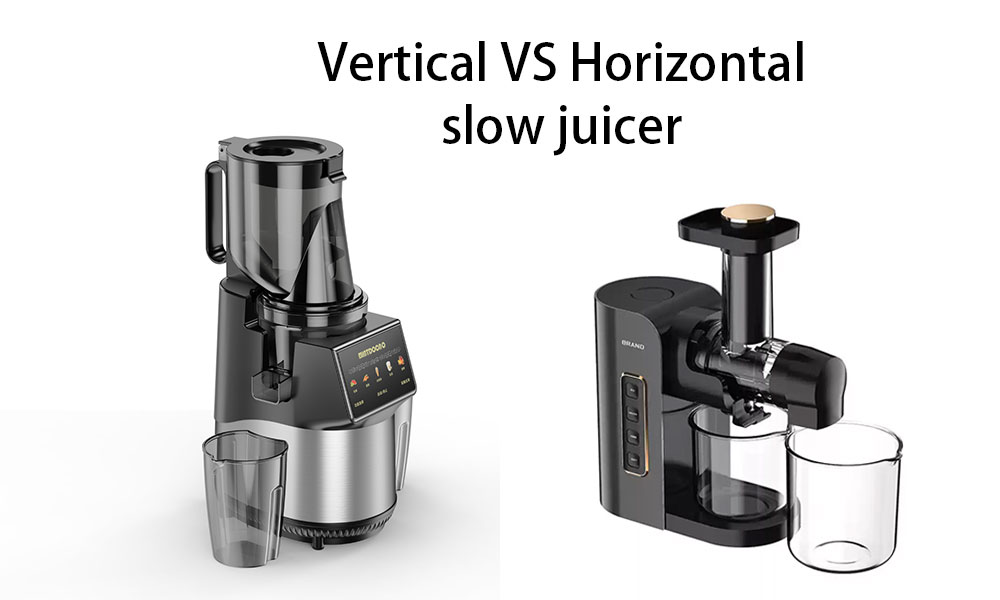
Vertical vs. Horizontal Performance Matrix
| Core Metrics | Vertical Masticating Juicers | Horizontal Masticating Juicers |
| Working Principle | Features a vertical auger that uses gravity to self-feed ingredients. Usually comes with a wide feeding chute. | Features a long horizontal auger. Requires manual feeding using a pusher to press ingredients against the screw. |
| Best-Suited Ingredients | Excellent for mixed fruits, soft fruits, and hard root vegetables (e.g., apples, oranges, carrots). | Ultimate choice for leafy greens, wheatgrass, and high-fiber celery. |
| Juice Yield | Root vegetables: 80–90%; Leafy greens: ~70%. | Root vegetables: 75–85%; Leafy greens & celery: up to 85%+ with extremely dry pulp. |
| Operating Noise | Ultra-low (typically 55–65 dBA, equivalent to a normal indoor conversation). | Low (60–70 dBA). The motor torque transmission path produces a slightly deeper, mechanical sound. |
| Durability & Lifespan | Ideal for light commercial or premium domestic use. Vertical bearings wear faster under continuous heavy-duty root vegetable crushing. | Extremely high. The horizontal shaft distributes force evenly, making it far better for prolonged, heavy commercial runs with minimal gear wear. |
| Footprint / Space | Small, compact footprint. Highly favored for modern home kitchens and tight commercial counter spaces. | Larger horizontal footprint. Requires wider countertop operating space. |
Sourcing Recommendation: If your target clients are juice bars, boutique hotels, or fast-paced home users who prefer wide feeding chutes to skip prep work, prioritize vertical models. If your buyers are specialized juice-cleanse brands or wellness purists seeking maximum yield from celery and leafy greens, you should source horizontal twin-gear or heavy-duty single-horizontal machines.
4. Professional Buyer’s Selection Checklist (2026 Edition)
Before placing an OEM/ODM order with a factory, evaluate product specifications against this technical checklist:
A. Motor Type (The Heart of the Machine)
- Commercial-Grade AC Induction Motor: The non-negotiable choice for commercial models. An operating speed of 40–60 RPM (Rotations Per Minute) is ideal, as low speeds minimize heat buildup and oxidation. AC motors deliver massive torque and can run continuously for over 30 minutes without triggering overheating protection.
- The Pitfall: Budget residential models often use DC motors or carbon brush motors. While lighter and cheaper, they heat up rapidly within 10 minutes and are entirely unfit for commercial environments.
B. Material Integrity & Safety
- Plastic Components: Must be explicitly certified as Tritan (supplied by Eastman USA) or Ultem (PEI resin). Ultem is widely used for heavy-duty augers and juicing screens; its hardness is several times that of standard plastics.
- Metal Components: The juice-contact zones (like the straining mesh and internal walls) must use SUS304 (or SUS316) food-grade stainless steel. Never accept low-cost SUS201, which rusts easily when exposed to acidic juices (like lemon or lime) over time.
C. Cleanability Design
End-users rank “difficult cleanup” as their number one pain point. The leading design trend in 2026 is Filter-free / Gridless technology. By utilizing dual interlocking, grooved structures instead of traditional micro-perforated stainless steel meshes, users can simply rinse the parts under a tap—slashing cleaning time from 10 minutes to under 2 minutes.
D. Supply Chain Baseline Metrics
- Standard Customization MOQ: Typically, OEM customization (custom silkscreen logos, bespoke packaging box) requires a Minimum Order Quantity of 500 to 1,000 units.
- Lead Time: First-time orders (including molding adjustments and packaging approval) generally take 45–60 days. Repeat orders drop down to a streamlined 30–35 days.
5. Four B2B Sourcing Traps and Real-World Case Studies
International sourcing mistakes often come with a staggering price tag due to information asymmetry. Here are four high-frequency traps encountered in the slow juicer supply chain:
Trap 1: Passing Off Domestic Motors as “Light-Commercial”
- Real Case: A healthy food delivery franchise in the UK imported 300 slow juicers from an online “Verified” supplier whose catalog claimed the units were “perfect for commercial juice bars.” Within two weeks of deployment, 15% of the machines experienced internal DC motor burnouts because they were kept running for over 45 minutes straight. The business faced production shutdowns and severe reputational damage.
- Prevention: Explicitly demand the Motor Temperature Rise Test Report in your contract. Ensure the “Continuous Rating Time” is legally bound to a minimum of 30–45 minutes of uninterrupted operation under load.
Trap 2: Using Counterfeit Tritan Plastics (Substituted with Standard PC)
- The Hazard: Standard Polycarbonate (PC) contains Bisphenol A (BPA), a chemical strictly banned or heavily regulated in food contact appliances across Europe and the Americas.
- Prevention: Do not rely on verbal or written “BPA-Free” claims from a factory. Insist on seeing the original raw material purchase invoices from Eastman USA, or run a targeted material composition test via SGS.
Trap 3: “Shadow Company” or Expired Certifications
- Real Case: An importer brought a shipment of slow juicers into the Port of Hamburg, Germany, presenting the CE and LFGB certificates supplied by the factory. Upon verifying the document numbers in the European central database, customs officers discovered that the certificate holder was a dissolved shell trading company, not the actual manufacturing facility. The entire shipment was seized and eventually destroyed at the buyer’s expense.
- Prevention: Before wire transferring funds, manually verify the certificate numbers on official registrar websites (such as the Intertek Directory or UL Product iQ). Cross-verify that the Company Name, Factory Address, and Product Model Number match perfectly.
Trap 4: Overlooking the Logistics “Drop Test”
- The Pain Point: Core slow juicer components (like Ultem augers, heavy bases, and thick plastic/tempered glass juice pitchers) are dense and heavy. If the internal foam packaging is inadequate, these components easily shatter during ocean transit or rough Amazon FBA last-mile delivery.
- Prevention: Require the factory to provide an ISTA 1A or 3A package drop test report. Alternatively, negotiate for the factory to include 3% extra wear-and-tear spare parts (such as silicone seals, pulp caps, and small gaskets) free of charge.
6. Summary & Next Steps
In 2026, winning the slow juicer market boils down to finding the perfect equilibrium between technological innovation (like wide-mouth self-feeding and filter-free cleaning), strict Western food-contact safety standards, and flexible manufacturing MOQs.
1.Define Target Audience:Days 1–5。
Establish whether your target market is premium residential (focusing on wide chutes, aesthetics, and quick cleaning) or commercial juice bars (focusing on AC induction motors, longevity, and NSF certification).
2.Supplier Screening:Days 6–15。
Filter suppliers on B2B platforms to find source manufacturers who can immediately provide valid, cross-verifiable ETL/NSF/CE certificates.
3.Sample Testing & Stress Run:Days 16–30。
Acquire sample units. Run a 100-hour cumulative durability and juice yield stress test in a lab or test kitchen using hard carrots and fibrous celery. Verify that operating noise stays under 65 dBA.
4.Lock In Compliance Clauses:Day 31 onwards。
When drafting the final Sales Contract (SC), make “materials fully compliant with LFGB/FDA food-grade standards,” “3-to-5-year core motor warranty,” and “2% complimentary spare parts package” non-negotiable terms.
Industry Insight: The cold-pressed slow juicer market boom is far from over, but the era of cutting corners with cheap materials is dead. The winners of 2026 will be the buyers who integrate compliance and exceptional user experience into every single node of their supply chain.