
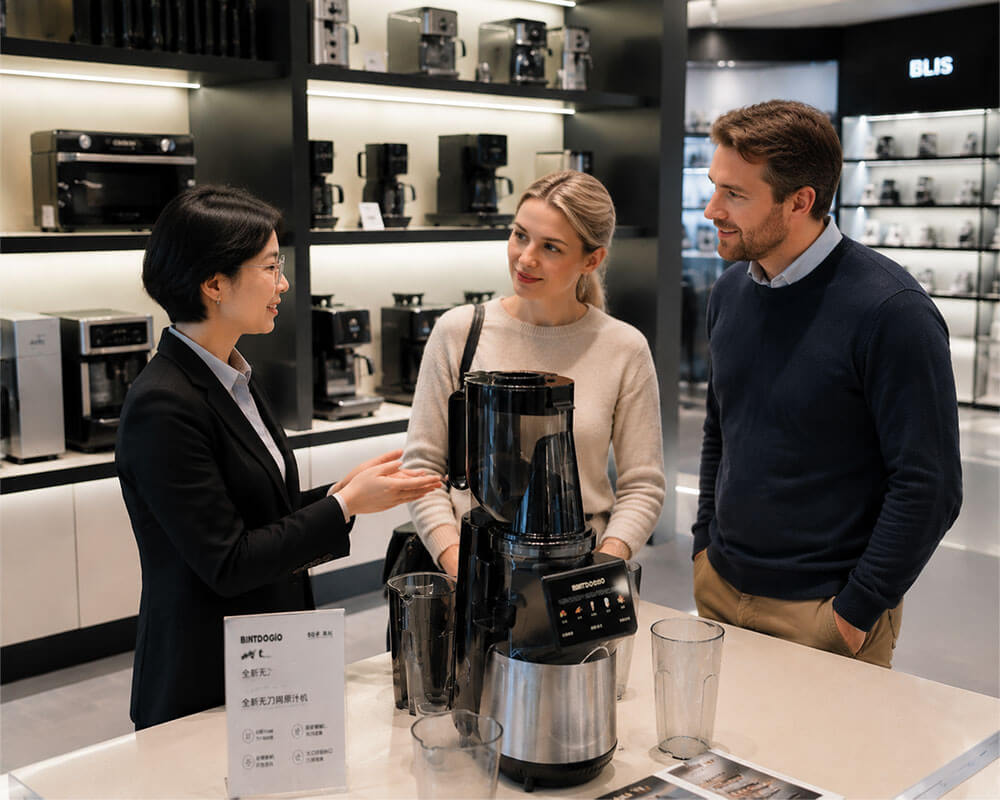
In cross-border e-commerce and foreign trade exports, slow juicers (also known as cold-press juicers or masticating juicers) are highly popular among European and American consumers due to their ability to preserve nutrients, low noise levels, and high juice yield. Many Chinese suppliers and factories regularly receive small-batch purchase orders (typically ranging from dozens to a few hundred units) from clients in Europe and the United States.
However, while small-batch procurement offers flexibility, it comes with significant risks. Issues such as non-compliant certifications, voltage mismatches, quality problems, or customs clearance delays can lead to cargo detention, returns, or even claims. This article provides a detailed breakdown of the key considerations for small-batch procurement of slow juicers by European and American customers, covering certification compliance, quality inspection, packaging and logistics, contracts and payments, and after-sales service. It aims to help suppliers and buyers avoid common pitfalls and close deals smoothly.
1. Certification and Compliance: The “Passport” to Enter European and American Markets
European and American markets impose extremely strict safety requirements on household appliances, especially those involving food contact. Small-batch orders are not exempt.
Core Certifications for the EU Market:
CE Certification (mandatory): Must comply with the Low Voltage Directive (LVD, standards EN 60335-1 + EN 60335-2-14) and the Electromagnetic Compatibility Directive (EMC). Products must bear the CE mark and be accompanied by a complete technical file and Declaration of Conformity (DoC).
RoHS and REACH: Restrictions on hazardous substances and chemicals.
Food-contact materials must comply with EC 1935/2004. For markets like Germany and Austria, additional LFGB certification is strongly recommended; otherwise, it is difficult to enter offline supermarket channels.
WEEE (Waste Electrical and Electronic Equipment) recycling markings must be included.
Core Certifications for the U.S. Market:
UL or ETL Certification (not legally mandatory but virtually required by platforms and retailers such as Amazon, Walmart, and Target): Based on UL 982, the safety standard for kitchen appliances.
FDA: All parts that come into contact with juice (plastic housings, filters, augers, silicone seals, etc.) must comply with 21 CFR food-contact material requirements, with migration test reports provided.
FCC: Ensures electromagnetic compatibility so the product does not interfere with other devices.
Special Notes for Small Batches:
Certification costs can be relatively high, so prioritize suppliers who already hold valid CE and UL reports. Avoid counterfeit certificates, as customs and platform inspections are strict. Voltage must be adapted correctly: 110-120V/60Hz with NEMA plugs for the U.S., and 220-240V/50Hz with corresponding country-specific plugs for Europe. User manuals and labels must be in the local language and include clear safety warnings.
These export certification requirements for slow juicers to Europe and the U.S. are the top priority for small-batch procurement. Confirming them in advance can prevent 90% of customs clearance issues.
2. Quality Control and Inspection: Small Batches Require Even Greater Precision
Factories often pay less attention to small-batch orders, leading to problems such as color variations, loose assembly, higher noise levels, inconsistent juice yield, or faulty safety locks.
Recommended Measures:
First purchase 1–3 sample units for real-world testing to verify juice yield, noise levels (ideally below 60–70 dB), ease of cleaning, and material feel.
Arrange a third-party pre-shipment inspection (PSI) after production, focusing on functional tests, appearance, packaging, labeling, and serial numbers.
Require food-grade materials (BPA-free plastics, 304 stainless steel) and request complete test reports.
Confirm the availability and supply cycle of wear parts (filters, augers).
For small-batch procurement of slow juicers by European and American customers, the inspection stage directly determines after-sales costs and customer satisfaction. It is advisable to clearly define AQL sampling standards and handling of non-conforming products in the contract.
3. Packaging, Logistics, and Customs Clearance Considerations
Slow juicers are fragile household appliances, so packaging must be robust for international shipping.
Use reinforced cartons + foam inserts + moisture-proof bags. Outer cartons should display CE/UL marks, country of origin (Made in China), model number, warning statements, and WEEE symbols.
For small batches, prioritize air freight or express shipping (faster transit) or sea freight LCL (less-than-container load). Pay attention to volumetric weight charging and calculate shipping costs in advance.
Documents must be complete and consistent: commercial invoice, packing list, bill of lading, certificate of origin, and certification documents. Confirm the HS code with the freight forwarder beforehand.
Tariff references: Approximately 8.5%–10% for electric kitchen small appliances in the EU; U.S. rates depend on the specific code, plus possible VAT/sales tax. For U.S. imports, pay attention to Prior Notice declarations.
Logistics Tip: Shipping in multiple batches can reduce the risk of a single shipment being inspected. Purchase cargo insurance and work with experienced freight forwarders familiar with customs clearance.
4. Contract, Payment, and Communication Details
Small-batch orders involve higher communication costs, so everything must be confirmed in writing.
Clearly specify MOQ, delivery time, quality standards, after-sales responsibilities, and spare parts supply.
Payment methods: Commonly 30% deposit + 70% balance before shipment (via T/T), or PayPal for even smaller quantities. Watch for exchange rate fluctuations and bank fees.
Time zone and language issues: Confirm all specifications (voltage, plugs, colors, logos, manual languages) via English emails to avoid verbal misunderstandings.
Customization requests (private labeling, special colors) are costly in small batches—try to use existing molds and standard configurations whenever possible.
Include quality deposit or third-party inspection clauses in the contract to protect both parties.
5. After-Sales Service and Product Liability
European and American consumers have strong rights awareness, so return rates and complaints cannot be ignored.
Provide a clear warranty policy (usually 1–2 years) and local after-sales contact information.
In the EU, an Authorized Representative must be appointed to handle recalls and complaints.
Consider purchasing product liability insurance.
Mark each unit with a unique serial number for traceability.
Timely supply of spare parts can significantly improve customer repurchase rates.
6. Cost Calculation and Supplier Selection Advice
Include all certification fees, shipping costs, tariffs, inspection fees, and potential return costs in the landed cost calculation for accurate pricing.
When selecting suppliers, prioritize those who:
Have proven export experience to Europe and the U.S. and existing valid certifications
Are willing to accommodate small batches and support inspections
Maintain a stable supply chain for food-grade materials
After successful sample validation, gradually scale up order volumes for the lowest risk.
Conclusion
The key considerations for small-batch procurement of slow juicers by European and American customers can be summarized as: certification compliance first, quality inspection second, voltage and plug adaptation third, complete packaging and logistics documents fourth, and solid contracts plus after-sales support fifth.
With proper preparation, small-batch orders can serve as an excellent entry point into the European and American markets. As the health-conscious eating trend continues, demand for slow juicers remains strong—compliant, high-quality products are far more likely to win long-term customers.
We hope this guide helps foreign trade professionals and buyers avoid common mistakes. If you have specific questions about certifications or logistics, feel free to leave a comment. Stay updated on the latest regulatory changes (especially tariffs and platform policies) to remain competitive in cross-border business.