In the current environment of global geopolitical volatility, supply chain uncertainty, and slowing economic growth, juice bars, health-focused restaurants, hotels, cafés, and small-to-medium fresh-pressed beverage businesses continue to have steady demand for high-nutrient-retention commercial slow juicers (also known as masticating juicers or cold-press juicers). These machines operate at low speeds (typically 40–110 RPM) using auger-style pressing technology to minimize oxidation, preserve enzymes and nutrients, and deliver high juice yield with dry pulp. They are ideal for processing fruits, vegetables, leafy greens, and wheatgrass.
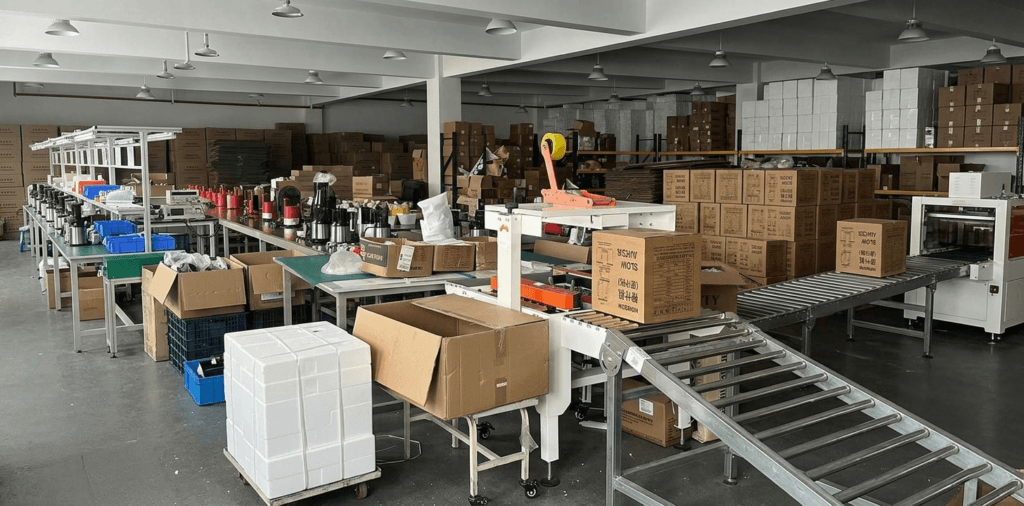
China remains the world’s primary manufacturing hub for slow juicers, with key industrial clusters in Zhongshan and Foshan (Shunde) in Guangdong, as well as Ningbo in Zhejiang. Leveraging complete supply chains for motors, augers, filters, and food-grade materials, plus mature OEM/ODM capabilities, China continues to be the preferred source for small-batch procurement. So, under turbulent conditions, how feasible is small-batch procurement of commercial slow juicers from China? What should buyers pay attention to? This article provides a systematic answer.

How Feasible Is Small-Batch Procurement of Commercial Slow Juicers from China?
Overall feasibility remains high, especially for market testing, store pilot operations, or small-to-medium commercial use.
- Industrial advantages remain strong: Zhongshan, Foshan, and surrounding areas offer vertically integrated supply chains that can quickly provide food-grade stainless steel, BPA-free materials, DC/AC motors, and wide-mouth feed chute designs. Commercial-grade models (continuous-duty, large feed chutes, automatic pulp ejection, low noise) have mature export channels. China holds a dominant position in the global cold-press juicer supply. Even during economic slowdowns, demand for healthy beverages and fresh-pressed juices continues to support baseline orders. accio.com
- Flexible MOQs can be negotiated: Standard models typically have MOQs of 200–500 units. Some factories accept trial orders of 50–100 units (or even lower) for existing molds, with samples available from as few as 10 units. Small batches can be handled via LCL (less-than-container-load) shipments, stock inventory, or semi-customization, effectively controlling inventory and capital occupation. made-in-china.com
- Cost competitiveness: FOB unit prices vary by power (150–300W is common for commercial models), materials, chute size, and certifications, but overall remain cost-effective. Even after adding freight and duties, landed costs are often lower than local production in Europe or North America or premium branded alternatives. Recent U.S.–China tariff adjustment frameworks covering certain non-sensitive goods (including some household and kitchen appliances) may indirectly benefit certain small appliances, though buyers must verify the latest tariff schedules for their destination country (e.g., U.S. HTS 8509.40 for juice extractors). tariffs.wove.com
- Manageable risks create a viable window: During economic downturns, factories often have more available capacity, offering greater flexibility on pricing and lead times. While global supply chains are diversifying, China remains the core node for high response speed and cost advantages. With proper verification and risk controls, small-batch procurement is still a practical and efficient option.
Overall assessment: For companies testing new products, expanding regionally, or managing tight cash flow, small-batch sourcing of commercial slow juicers from China remains more realistic than immediately shifting to alternative origins.
Key Considerations for Small-Batch Procurement of Commercial Slow Juicers from China
In a turbulent environment, the main risks center on supplier authenticity, quality consistency (especially juice yield and durability), logistics delays, tariff fluctuations, and compliance. Prioritize the following areas:
1. Supplier Screening and Verification (Most Critical)
Prefer actual factories in Zhongshan or Foshan over pure trading companies. Screen on platforms such as Alibaba or Made-in-China for Gold/Audited Suppliers, transaction history, and third-party factory audit reports. Request business licenses, ISO certificates, production videos, and proof of past orders. Be wary of unusually low quotes and “fake factories.” For small batches, prioritize suppliers with existing molds who are willing to accept lower MOQs.
2. Quality Control and Sampling
Core factors for commercial slow juicers include: auger material and durability, continuous motor performance, juice yield (must be tested with actual produce), pulp dryness, noise control, wide feed chute, and ease of cleaning. Always obtain samples first (paid or negotiated), test them with your target ingredients, and confirm consistency with bulk production. Require pre-production and pre-shipment inspections (PSI) using AQL standards. Clearly define acceptance criteria and liability for non-conformance in the contract to avoid sample-to-bulk discrepancies.
3. Certifications and Compliance
Match certifications to the target market: CE, UL/ETL, RoHS, LFGB, and food-contact material compliance are common for Europe and North America; other regions require corresponding local standards. Verify that certificates are authentic and cover the specific model to avoid customs or market-entry issues. Electrical safety and food-contact materials are especially critical.
4. Logistics, Lead Times, and Cost Calculation
Small batches typically use LCL consolidation or air freight (for urgency). Sea freight usually takes 20–40 days and can be extended by port congestion or geopolitical events. Under FOB terms, the supplier handles export customs clearance while the buyer controls the international leg. Calculate the full landed cost: unit price + freight + insurance + duties + customs clearance + inland transportation. Build in buffer inventory and time.
5. Payment, Contracts, and Risk Hedging
Use platform Trade Assurance, letters of credit, or staged payments (deposit + balance after inspection). Avoid full prepayment. Contracts should clearly specify specifications, lead times, warranty (typically one year), spare parts (augers, screens, and other wear items), and dispute resolution. Monitor exchange-rate fluctuations and consider locking rates or diversifying payment methods. In a geopolitically uncertain environment, start with partial trial orders and maintain backup suppliers.
6. Other Practical Tips
- Prefer standard models to reduce tooling costs and lead times.
- Request a spare-parts list and after-sales support details (commercial use typically involves higher wear-part replacement frequency).
- Watch for upward pressure on raw material (plastics, stainless steel, copper) and labor costs.
- For OEM projects, clearly define intellectual property and mold ownership.
- Confirm voltage, plug type, and compatibility with local power standards.
Conclusion and Action Recommendations
Despite global turmoil and economic slowdown, small-batch procurement of commercial slow juicers from China remains highly feasible. The core advantages lie in the mature industrial clusters, negotiable MOQs, and overall cost performance. The key is to address risks upfront: factory verification, sample testing with real ingredients, inspections, compliance, and full landed-cost calculation.
Recommended starting steps:
- Clearly define power, chute size, continuous-duty requirements, and target-market certifications.
- Shortlist 3–5 suppliers in Zhongshan/Foshan, request samples, and compare juice yield using actual produce.
- Calculate complete landed costs and negotiate a trial order.
- Engage third-party quality inspection and a professional freight forwarder.
By executing rigorously, businesses can still secure high-performance commercial slow juicers even in an uncertain environment and support continuous fresh-pressed juice operations. If you are planning a specific purchase, refine the plan further with the latest tariff and logistics information. Continuously monitoring supply-chain dynamics will help you seize opportunities amid volatility.