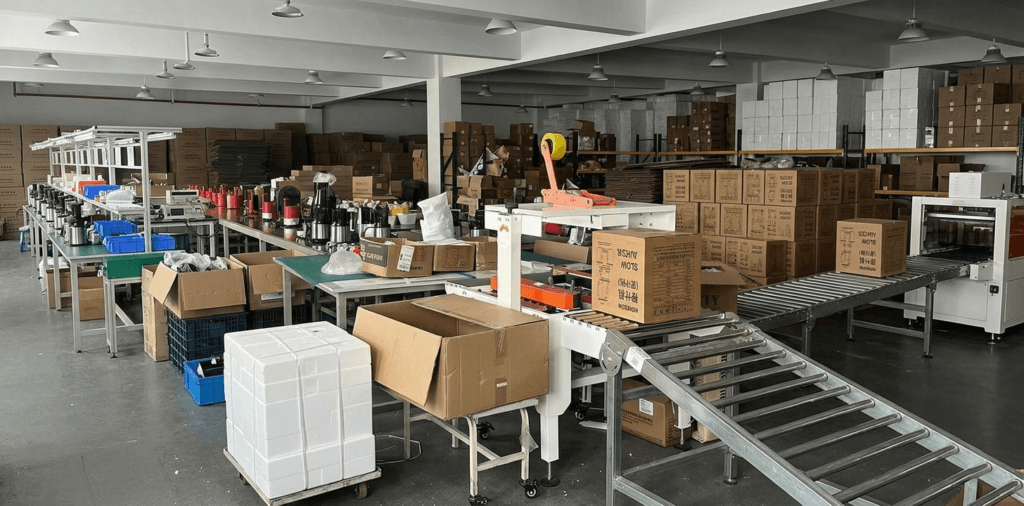
Yes. Restaurants, juice bars, cafés, hotels, health food stores and other foodservice businesses can purchase commercial slow juicers directly from Chinese manufacturers and suppliers.
For small and medium-sized businesses, buying a commercial slow juicer from China can be an attractive alternative to purchasing through local distributors. Depending on the supplier, buyers may have access to competitive factory pricing, low minimum order quantities, OEM and private-label services, replacement parts and international shipping.
The key is to choose the right commercial juicer and verify important factors such as electrical specifications, food-contact materials, safety certifications, motor performance, continuous operating capability, warranty and after-sales support.
What Is a Commercial Slow Juicer?
A commercial slow juicer, also known as a commercial cold press juicer or commercial masticating juicer, extracts juice by slowly crushing and pressing fruits and vegetables.
Unlike traditional high-speed centrifugal juicers, slow juicers typically operate at a lower speed and are designed to minimize heat and oxidation during the extraction process.
Commercial slow juicers are commonly used by:
- Juice bars
- Smoothie shops
- Restaurants
- Cafés
- Hotels
- Health food stores
- Organic food businesses
- Catering companies
- Fitness and wellness businesses
- Food trucks
The exact performance and operating capabilities vary between models, so buyers should evaluate the machine according to their expected daily workload.
Can Small Restaurants Buy Commercial Slow Juicers From China?
Yes.
A common misconception is that Chinese manufacturers only accept large wholesale orders.
In reality, some suppliers offer low MOQ commercial juicers and sample orders, allowing small businesses to purchase a limited number of machines before committing to a larger order.
For example, a new juice bar may initially need:
- 1 commercial slow juicer
- 1 backup machine
- Several replacement parts
A small restaurant may only need two or three machines.
A growing juice bar chain may later require 10, 20 or more machines.
This makes low-MOQ sourcing particularly useful for small and medium-sized foodservice businesses.
Why Buy a Commercial Slow Juicer From China?
There are several reasons why restaurants and beverage businesses consider Chinese suppliers.
1. Competitive Factory Pricing
Purchasing directly from a manufacturer can reduce the number of intermediaries involved in the supply chain.
This may provide a more competitive cost compared with purchasing the same type of equipment through multiple distribution channels.
However, buyers should compare the total landed cost, not just the factory price.
Total cost can include:
- Product price
- Packaging
- International shipping
- Import duties
- Customs clearance
- Local delivery
- Payment fees
- Spare parts
- Warranty costs
A low factory price does not automatically mean the lowest final cost.
2. Low MOQ
Low minimum order quantities can be especially useful for new restaurants and independent juice bars.
Depending on the supplier, buyers may be able to start with:
1 unit → product testing
10–20 units → small chain
2–5 units → small restaurant or juice bar
50+ units → distributor or wholesale project
MOQ varies by manufacturer, model and customization requirements, so it should always be confirmed before ordering.
3. OEM and Private Label
Businesses that want to develop their own brand can also consider working with a commercial juicer manufacturer in China.
OEM and private-label services may include:
- Custom logo
- Custom packaging
- Brand labeling
- Product color customization
- Accessories
- User manuals
- Customized specifications
The MOQ for OEM production is normally different from the MOQ for standard products.
Who Needs a Commercial Slow Juicer?
Juice Bars
Juice bars are one of the most obvious applications for commercial cold press juicers.
A juice bar may use a slow juicer for:
- Apple juice
- Carrot juice
- Celery juice
- Green juice
- Ginger juice
- Vegetable juice
- Fruit and vegetable blends
For a juice bar, important factors include extraction performance, operating capacity, cleaning time and reliability.
Restaurants
Restaurants can use commercial slow juicers for fresh juice, specialty beverages and healthy menu items.
A restaurant may not require the same capacity as a high-volume juice production facility, making a compact commercial model an attractive option.
Cafés
Cafés may use commercial juicers for fresh juice and health-focused beverages.
Compact dimensions and easy cleaning can be especially important where counter space is limited.
Hotels
Hotels may require commercial juicers for breakfast service, restaurants, bars and wellness areas.
In this environment, reliability and continuous operating capability should be considered carefully.
Health Food Stores
Health food stores and organic food businesses may use cold press juicers to prepare fresh juices for customers.
These businesses may place greater emphasis on juice quality, ingredient handling and presentation.
Small Foodservice Businesses
Food trucks, catering companies and small beverage businesses may also benefit from commercial slow juicers when fresh juice is part of their product offering.
Commercial Slow Juicer vs Household Slow Juicer
One of the most important purchasing decisions is choosing a genuinely commercial machine rather than simply using a household model in a professional environment.
Household Slow Juicer
Generally designed for:
- Home users
- Lower daily volume
- Intermittent operation
- Smaller workloads
Commercial Slow Juicer
Generally designed for:
- Restaurants
- Juice bars
- Cafés
- Hotels
- Foodservice businesses
- Higher-frequency operation
Commercial models may feature:
- Stronger motors
- More durable components
- Larger feed chutes
- Larger juice containers
- Better cooling systems
- Longer operating cycles
- Commercial-grade construction
- Easier maintenance
The exact specifications depend on the manufacturer and model.
Do not assume that a product is commercial simply because the product listing uses the word “commercial.”
Ask the supplier for the actual duty cycle, motor specifications, test information and intended application.
What Should You Look for When Buying a Commercial Slow Juicer?
Choosing a commercial slow juicer involves more than comparing motor wattage.
1. Motor Performance
Consider:
- Motor power
- Motor type
- Operating speed
- Thermal protection
- Overload protection
- Continuous operating capability
A higher wattage does not automatically mean better juicing performance.
The machine should be evaluated according to the ingredients and workload it is designed to handle.
2. Feed Chute Size
A wider feed chute can reduce the amount of preparation required before juicing.
For a busy juice bar, reducing cutting and preparation time can help improve employee productivity.
When comparing commercial juicers, check:
- Feed chute diameter
- Maximum ingredient size
- Whether whole or partially cut produce can be processed
- Recommended preparation requirements
3. Juice Yield
Juice yield is one of the most important performance indicators.
Buyers should test the machine using the actual ingredients they plan to process.
For example:
- Apples
- Carrots
- Celery
- Leafy greens
- Ginger
- Citrus
- Soft fruits
Different machines can perform differently depending on the ingredients.
4. Cleaning and Maintenance
A commercial juicer may be cleaned several times every day.
Therefore, easy cleaning can have a significant effect on labor efficiency.
Look for features such as:
- Easy disassembly
- Simple strainer cleaning
- Tool-free assembly
- Easy-rinse components
- Replaceable seals
- Readily available spare parts
A machine that takes significantly less time to clean can be more valuable to a busy restaurant than one with slightly higher motor power.
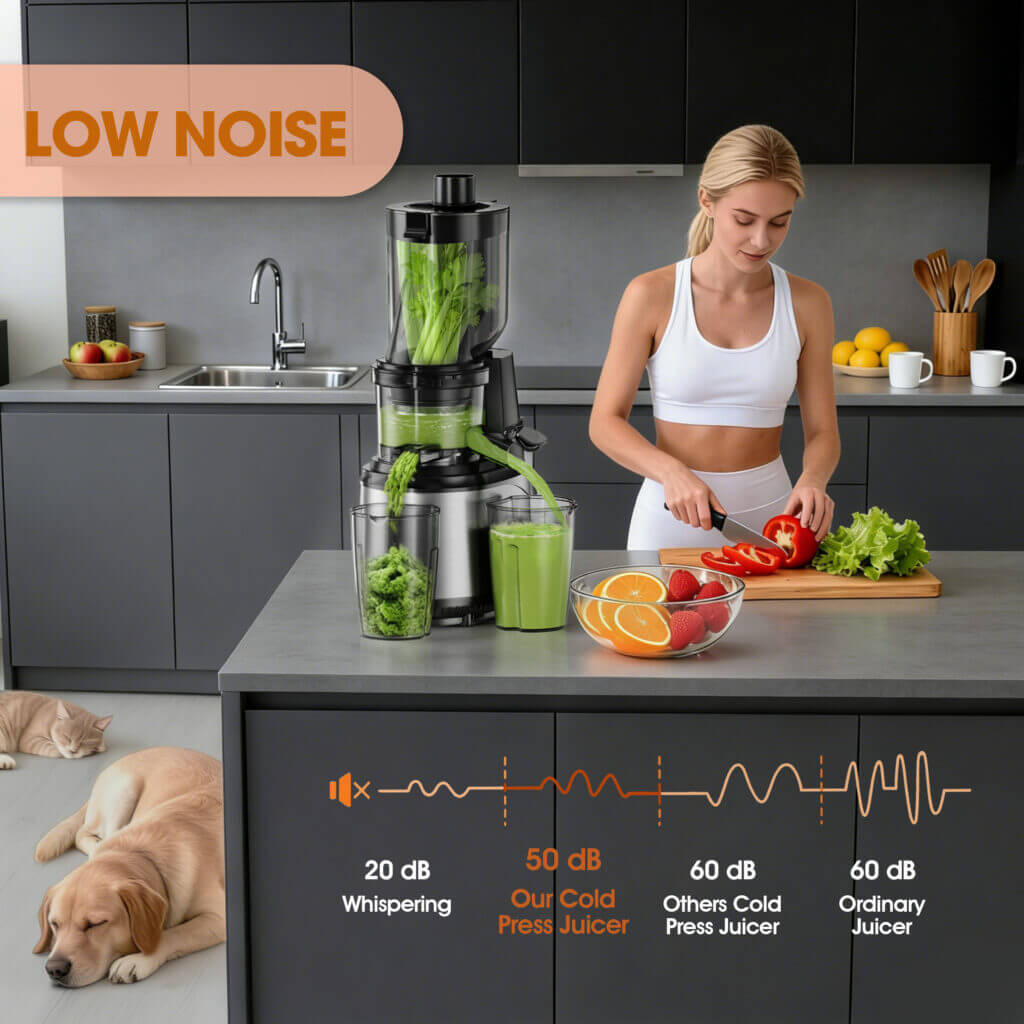
5. Noise Level
Noise can be an important consideration in customer-facing businesses.
A juice bar, café or hotel may prefer a quieter machine, especially when the equipment is operated near customers.
When evaluating suppliers, ask for actual noise measurements or test the machine in a real operating environment.
What Certifications Does a Commercial Slow Juicer Need?
Certification requirements depend on the destination market, product design and intended use.
For US buyers, commercial foodservice equipment may involve standards and certifications such as NSF, UL or ETL, depending on the equipment and application.
For European markets, requirements can involve CE, EMC, LVD and RoHS, as applicable.
The most important rule is:
Always verify certification for the specific model and factory.
A supplier having certification for one product does not automatically mean that another model has the same certification.
Buyers should request relevant certification documents and verify that the model number and manufacturing facility match the product being purchased.
Can a Chinese Commercial Juicer Meet US or European Requirements?
Yes, Chinese manufacturers can produce commercial juicers for international markets.
However, compliance should be evaluated on a product-by-product basis.
For the United States, buyers should confirm:
- Voltage
- Frequency
- Plug type
- Electrical safety requirements
- Applicable foodservice sanitation requirements
- Food-contact materials
- Certification documentation
For Europe, buyers should confirm:
- Voltage
- Frequency
- CE compliance
- EMC requirements
- LVD requirements where applicable
- RoHS requirements
- Food-contact material requirements
Do not rely solely on statements such as “CE certified” or “US standard.”
Request documentation and verify the actual model.
Why Spare Parts Matter
Spare parts are particularly important for commercial foodservice equipment.
A restaurant cannot afford unnecessary downtime because a small component is unavailable.
Common commercial slow juicer replacement parts may include:
- Augers
- Strainers
- Juicing bowls
- Juice containers
- Pulp containers
- Lids
- Pushers
- Sealing rings
- Blade components
- Couplings
Before purchasing, ask the supplier:
Are replacement parts available?
How much do they cost?
How long does delivery take?
Can spare parts be ordered separately?
A supplier that provides long-term spare-parts support can be more valuable than a supplier offering only the lowest initial price.
Is Buying 1–10 Commercial Slow Juicers From China Worth It?
For some businesses, yes.
Consider a small juice bar that needs three commercial slow juicers.
Buying through a local distributor may offer faster delivery and local service, but the product price may be higher.
Buying directly from China may provide:
- Lower factory pricing
- More product choices
- Low MOQ
- Direct communication with the manufacturer
- OEM opportunities
- Spare-parts sourcing
However, the buyer also needs to consider:
- International shipping
- Import procedures
- Taxes and duties
- Warranty handling
- Delivery time
- Product certification
- After-sales service
The best option depends on the buyer’s location, order quantity and business requirements.
How to Find a Reliable Commercial Slow Juicer Supplier in China
Before placing an order, ask potential suppliers for:
- Company profile
- Factory information
- Product specifications
- Motor specifications
- Duty-cycle information
- Certification documents
- Food-contact material information
- Warranty policy
- Spare-parts list
- MOQ
- Sample order terms
- Production lead time
- Packaging details
- Shipping options
If possible, order a sample before placing a large order.
A sample allows you to test the actual machine rather than relying only on product photographs and specifications.
Why Sample Testing Is Important
A commercial slow juicer should be tested using the same ingredients and workload expected in the customer’s business.
During testing, evaluate:
Juice Yield
How much juice can the machine produce from the same quantity of ingredients?
Pulp Quality
Is the remaining pulp relatively dry?
Continuous Operation
Can the machine handle the expected workload without overheating or excessive downtime?
Cleaning
How quickly can employees disassemble and clean the machine?
Noise
Is the noise level acceptable for the restaurant environment?
Durability
Does the machine remain stable after repeated use?
Customer Support
Can the supplier provide technical assistance and replacement parts?
These tests can help reduce the risk of purchasing unsuitable equipment.
How Much Does a Commercial Slow Juicer Cost?
Commercial slow juicer prices vary significantly depending on specifications, brand, certifications, production volume and market.
A basic commercial model may have a relatively low factory price, while premium commercial cold press juicers with advanced designs, certifications and higher operating capabilities can cost considerably more.
For example, premium commercial models sold in the US market can retail for more than $1,000.
This creates a potential opportunity for businesses to compare:
Local retail price
versus
China factory price + shipping + import costs
The correct comparison is always the final landed cost.
Should Restaurants Buy Commercial Slow Juicers Directly From China?
For small and medium-sized foodservice businesses, direct sourcing from China can be worth considering.
The model is particularly attractive when a business wants:
- 1–10 machines
- Competitive pricing
- Low MOQ
- OEM/private label
- Replacement parts
- Direct manufacturer communication
- Long-term purchasing relationships
However, buyers should not choose a supplier based only on price.
The most important factors include:
Product quality
Certification
Electrical compatibility
Commercial duty cycle
Food-contact materials
Warranty
Spare parts
Shipping
After-sales support
Final Thoughts
A restaurant does not necessarily need to purchase a commercial slow juicer from a local distributor.
For businesses that only need a few machines, a qualified commercial slow juicer supplier in China can provide an alternative sourcing option with competitive factory pricing and flexible order quantities.
The most practical approach is to start with a sample or small order, test the machine under real business conditions, and then consider larger repeat orders if the equipment meets expectations.
For juice bars, restaurants, cafés, hotels, health food stores and other foodservice businesses, sourcing a commercial cold press juicer directly from China can potentially reduce equipment costs while providing access to OEM manufacturing, replacement parts and a wider range of commercial juicing solutions.
If you are looking for a commercial slow juicer for your business, compare the machine’s total landed cost, certifications, operating capability, warranty and spare-parts support—not just the factory price.